
Evidence of Action Plans in Trauma Performance Improvement: When “We Talked About It” Is No Longer Enough
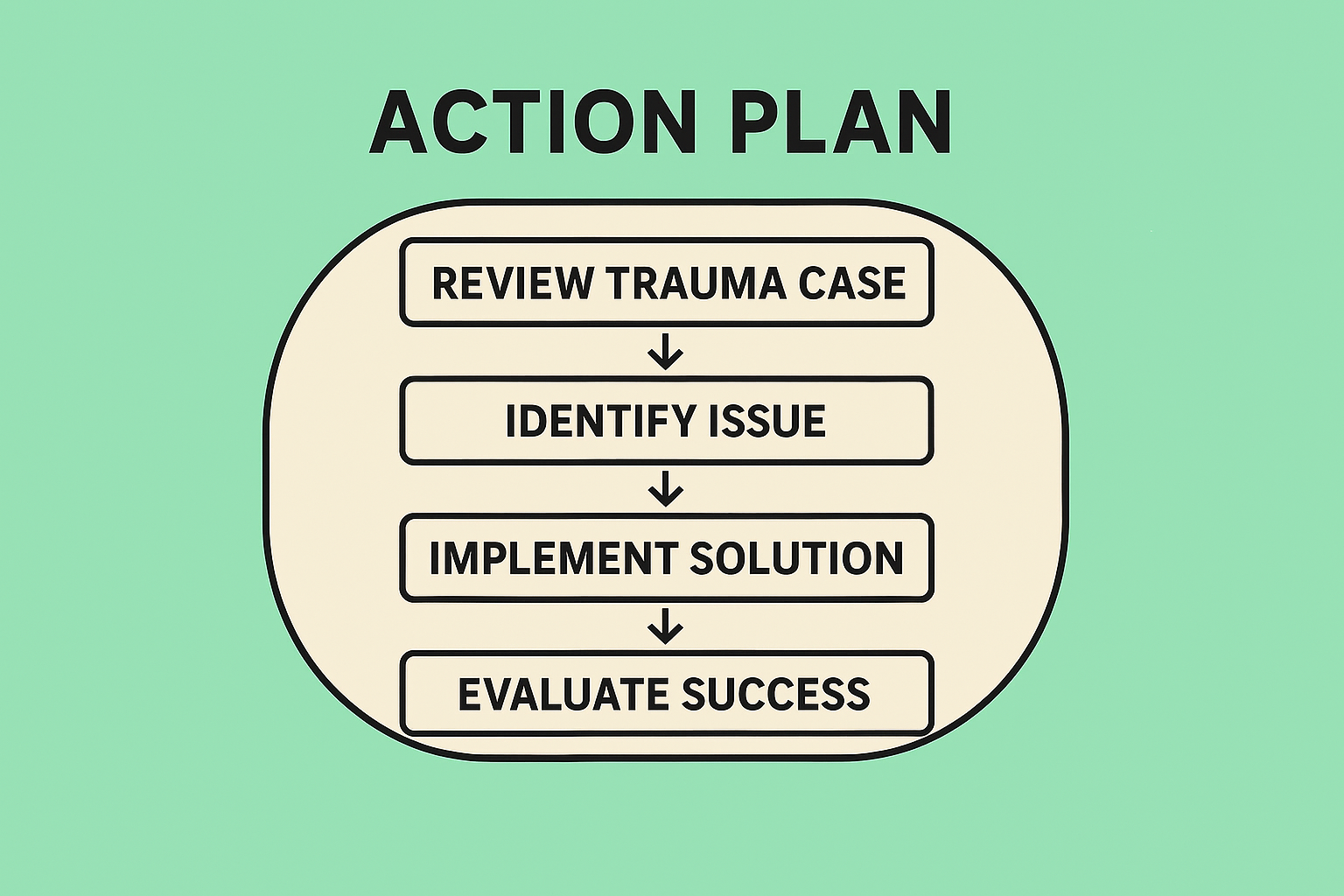
In trauma performance improvement (PI), identifying a problem is the easy part. Documenting an action plan is the expected part. Demonstrating evidence that the action plan actually worked—that’s where many trauma programs start to sweat, usually about three weeks before a verification visit.
The American College of Surgeons (ACS) has been clear: performance improvement and patient safety (PIPS) is not a paperwork exercise. It is a closed-loop system designed to prevent harm to future similar patients (American College of Surgeons [ACS], 2022). In other words, trauma PI is not about proving that you noticed a problem—it is about proving that you changed something and that the change mattered.
This article explores what “evidence of action plans” really means in trauma PI, why it is a common stumbling block, and how trauma programs can move from well-intentioned plans to defensible, data-backed improvement.
Action Plans: Necessary but Not Sufficient
An action plan answers the question: What are we going to do differently next time?
Evidence answers the more important question: Did it actually happen—and did it help?
According to the ACS Resources for Optimal Care of the Injured Patient, trauma centers must not only develop corrective actions but must also demonstrate problem resolution, outcome improvement, and assurance of patient safety, collectively referred to as loop closure (ACS, 2022). Failure to provide this evidence remains one of the most common reasons for PI-related deficiencies during trauma verification.
Common pitfalls include:
Education without follow-up
Policy changes without compliance monitoring
Provider feedback without reassessment
“Ongoing monitoring” with no defined metric
In trauma PI, intent does not equal impact, and surveyors are trained to tell the difference.
What Counts as Evidence in Trauma PI?
Evidence of an action plan is objective, measurable, and time-bound. It demonstrates that the intervention occurred and that its effectiveness was assessed.
Examples include:
Pre- and post-intervention data (e.g., response times, compliance rates, complication trends)
Audit results demonstrating sustained adherence
TQIP or registry data showing improvement or stabilization
Re-review of similar cases confirming the issue did not recur
The 2022 ACS standards emphasize effectiveness over activity, shifting the focus away from “checking the box” and toward demonstrable improvement (ACS, 2022).
In short, if the only proof an action plan occurred is a meeting minute, the loop is still open.
PDSA: The Unsung Hero of Defensible Action Plans
The Plan–Do–Study–Act (PDSA) cycle remains one of the most effective frameworks for generating evidence in healthcare quality improvement. When applied correctly, it transforms action plans from static promises into testable interventions (Reed & Card, 2016; AMA, 2023).
Plan: Define the problem, the intervention, and the expected outcome
Do: Implement the change on a small or defined scale
Study: Analyze data to determine whether the change led to improvement
Act: Adopt, adapt, or abandon the intervention based on results
Importantly, PDSA emphasizes learning, not perfection. Even an unsuccessful intervention can demonstrate effective PI if the program studied the outcome and adjusted accordingly (Reed & Card, 2016).
In trauma PI, a failed action plan that is reassessed and refined is far more defensible than a “successful” one that was never measured.
Education Is Not a Free Pass
Education is a common corrective action—and one of the weakest when used alone. Multiple guidelines caution that education without evaluation rarely produces sustained change (Washington State Department of Health, 2021).
To elevate education into evidence, trauma programs should pair it with:
Knowledge assessments
Direct observation or chart audits
Compliance tracking over time
For example, documenting that trauma activation criteria were re-educated is helpful. Demonstrating a measurable reduction in under-triage afterward is powerful.
Surveyors are not anti-education. They are anti-assumption.
Evidence Protects More Than Your Verification Status
Robust evidence of action plans does more than satisfy ACS standards—it strengthens trauma program culture. Programs that consistently close the loop:
Reduce variation in care
Improve interdisciplinary accountability
Normalize data-driven decision-making
Protect providers by addressing system issues proactively
Most importantly, they improve outcomes for patients who will never know their injury was prevented by a PI meeting six months earlier.
That is the quiet success story of trauma PI done well.
Call to Action: Make Evidence Your Default
If your trauma PI files still rely on phrases like “will continue to monitor” or “education was provided”, now is the time to level up.
Ask yourself and your team:
How do we know this action plan worked?
Where is that proof documented?
Could someone outside our program understand it in five minutes?
Build evidence into your action plans from the start. Define the metric. Assign the re-evaluation. Close the loop—then show your work.
Because in trauma PI, the most convincing statement is not “we fixed it”—
it is “here’s the data.”
References
American College of Surgeons. (2022). Resources for optimal care of the injured patient. https://www.facs.org/quality-programs/trauma/quality/verification-review-and-consultation-program/
Reed, J. E., & Card, A. J. (2016). The problem with Plan–Do–Study–Act cycles. BMJ Quality & Safety, 25(3), 147–152. https://doi.org/10.1136/bmjqs-2015-005076
American Medical Association. (2023). Plan–Do–Study–Act (PDSA): A step-by-step approach to improve quality. https://edhub.ama-assn.org/steps-forward/module/2702507
Washington State Department of Health. (2021). Trauma quality improvement guideline. https://doh.wa.gov/sites/default/files/2022-02/530247-TraumaQIGuideline.pdf
