
Levels of Lifesaving: The ACS Trauma Breakdown You’ll Actually Want to Read
Because not all trauma centers are created equal—and that’s a good thing.
If trauma system terminology has ever made you wonder whether someone spilled a box of Roman numerals across your policy manual, you’re not alone. Across the United States, trauma centers are categorized from Level I through Level V, but the levels available depend on who is doing the categorizing.
That’s because ACS verification and state trauma designation operate under different authorities and serve different purposes (American College of Surgeons [ACS], n.d.); American Trauma Society, n.d.). Understanding this distinction is essential for clinicians, program leaders, and anyone working within a trauma system.
ACS Verification vs. State Designation: What’s the Difference?
ACS Trauma Center Verification (National Standards)
The American College of Surgeons (ACS) verifies trauma centers using the Resources for Optimal Care of the Injured Patient—a national standard often called the Gray Book. The ACS currently verifies only three trauma levels:
Level I
Level II
Level III
ACS explicitly states that “there are three levels of ACS trauma center verification” (ACS, n.d.).
ACS verification evaluates whether a hospital meets nationally standardized criteria for trauma resources, staffing, performance improvement, and patient care processes.
State Trauma Center Designation (State-Specific Authority)
States—not the ACS—have the legal authority to designate trauma center levels. State designation systems may include:
Levels I–IV
Levels I–V
For example, Colorado formally defines Levels I–V in its state trauma regulations (Colorado Department of Public Health & Environment, 2020).
This means a hospital can be a state-designated Level IV or V, even though ACS verification stops at Level III.
What Each Trauma Center Level Means
Below is a simplified overview of trauma center levels as commonly used in U.S. systems, synthesizing ACS verification standards with state-level designation frameworks.
Level I: The Major‑League Trauma Titans
Level I Trauma Centers are the full‑service hospitals that never sleep because trauma never does. They represent the highest level of trauma care, offering comprehensive services 24/7/365 (ACS, 2022).
What makes Level I special:
24/7 in‑house trauma surgeons, with prompt availability of subspecialists including orthopedics, neurosurgery, anesthesiology, and more (American Trauma Society, n.d.).
Advanced imaging and immediate operating room availability.
Research powerhouses—Level I centers must demonstrate ongoing trauma-related research and scholarly activity (ACS, 2014).
Education hubs offering surgical residency training and community outreach.
High patient volume, ensuring consistent exposure to severe trauma.
In short: Level I is the trauma world’s equivalent of a top-tier academic medical center and all-around trauma command center.
Level II: Highly Skilled, High‑Readiness Workhorses
Level II Trauma Centers deliver nearly all of the clinical capabilities of Level I but without the same research and residency program requirements (American Trauma Society, n.d.).
What they provide:
24/7 immediate availability of trauma surgeons and essential specialists.
Ability to manage most trauma cases independently, with transfers to Level I only when highly specialized resources are needed (TCAA, n.d.).
Robust and reliable trauma care across all hours.
In short: Everything you need, minus the academic homework.
Level III: Stabilizers and Lifesavers
Level III Trauma Centers are designed to rapidly assess, resuscitate, perform emergency surgery, and stabilize patients. After that, they determine whether continued care or transfer is best (ACS, 2014).
Key features:
Trauma surgeons promptly available—though not always in-house 24/7.
24/7 emergency medicine coverage.
Critical care services and operating room capability.
Strong focus on timely transfers to Level I or II centers when needed (ACS, 2022).
In short: The essential middle players—keeping patients alive and safely moving through the system.
Level IV: First Responders of the Hospital World (State-Designation Only)
Used primarily in state systems, Level IV centers offer 24/7 emergency evaluation, stabilization, and transfer capability. Surgical resources may be limited or optional depending on state requirements (Colorado Department of Public Health & Environment, 2020).
What they bring to the table:
24/7 emergency department readiness.
The ability to evaluate, stabilize, and prepare patients for transfer to higher-level centers.
Basic surgical capabilities may be present but are not required.
A strong emphasis on efficient triage and rapid transport (ACS, 2014).
In short: Skilled frontline triage experts—fast, flexible, and focused.
Level V: Basic Emergency Stabilization (State‑Designated Only)
Level V centers exist only in certain state systems—they are not verified by ACS. These centers provide initial evaluation, essential stabilization, and coordinated transfer, and often serve rural or frontier regions (Colorado Department of Public Health & Environment, 2020).
Why Do Some States Use Levels I–IV While Others Use Levels I–V?
1. ACS Verification Stops at Level III
The ACS has never verified Level IV or V trauma centers. Its scope ends at Levels I–III (ACS, n.d.).
States created Levels IV and V to fill gaps in regional trauma coverage.
2. States Tailor Levels to Local Geography and Needs
Designation decisions often reflect geography, population density, and rural access needs.
States with large rural expanses—such as Colorado—use Level V to ensure emergency access in areas far from surgical facilities (Colorado Department of Public Health & Environment, 2020).
3. States Have Independent Legal Authority
State health departments define trauma levels legislatively or through regulatory authority. Systems differ widely across the country due to local policy and resource structures (American Trauma Society, n.d.).
4. ACS Verification Focuses on Standards; State Designation Focuses on System Coverage
ACS sets hospital‑level resource and quality standards, while states build regional trauma systems that ensure coverage from urban centers to rural clinics (ACS, n.d.; American Trauma Society, n.d.).
Why This Distinction Matters
Understanding the difference between ACS verification and state designation helps trauma professionals:
Educate teams accurately
Prepare for ACS verification vs. state surveys
Communicate expectations about hospital capabilities
Strengthen regional coordination
Ensure patients are routed to the right facility at the right time
Trauma systems depend on getting the right patient to the right place at the right time—a foundational principle emphasized across ACS trauma standards (ACS, 2022). Each level contributes to a regional trauma ecosystem that turns chaos into coordinated care.
Putting It All Together
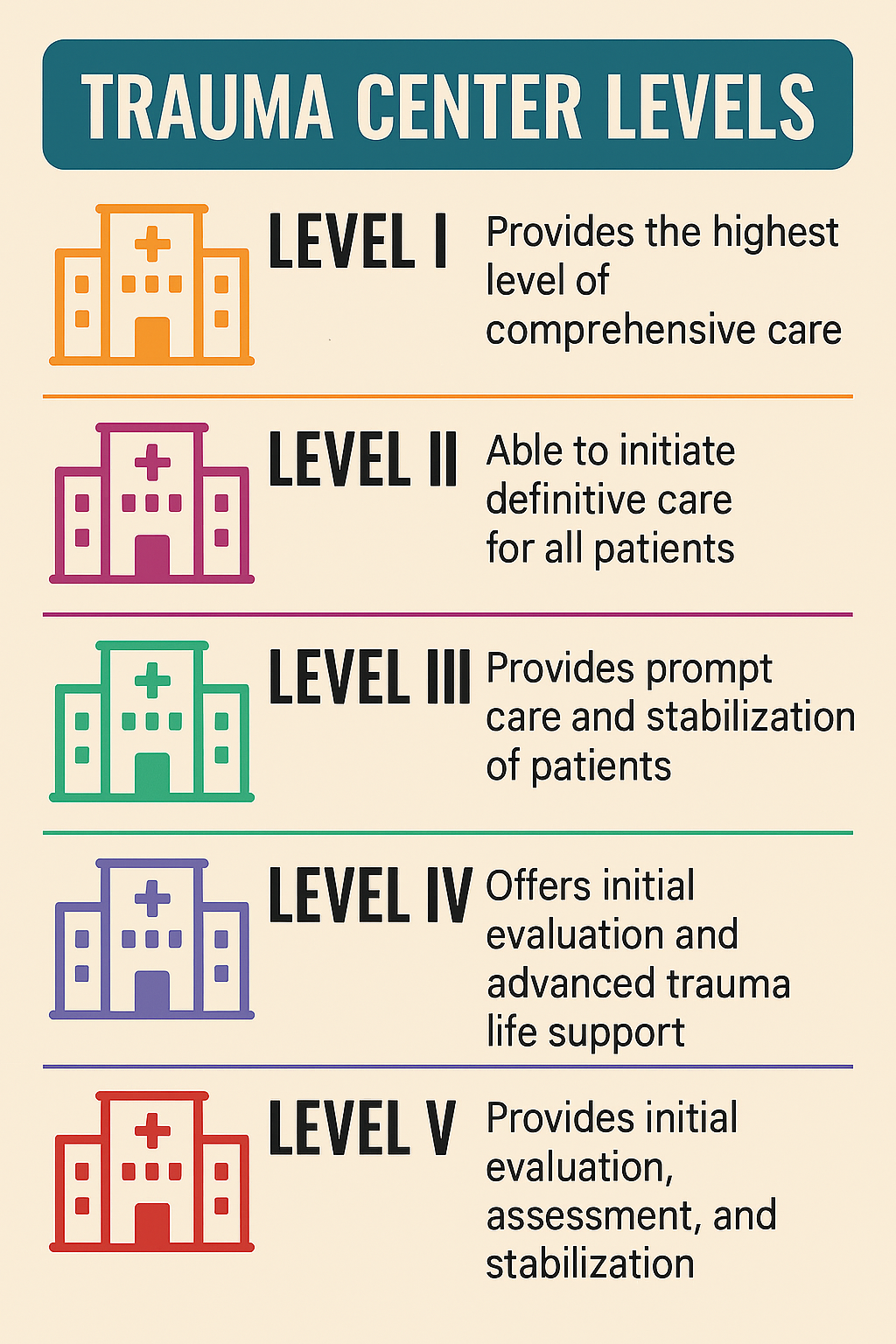
Here’s the simplest way to think about ACS levels:
These role distinctions correspond directly with the national ACS standards and trauma system guidelines (ACS, 2022; ACS, 2014).
References
American College of Surgeons. (n.d.). About the Trauma Verification, Review, and Consultation Program. https://www.facs.org/quality-programs/trauma/quality/verification-review-and-consultation-program/about-vrc/
American College of Surgeons. (2014). Resources for optimal care of the injured patient. https://georgiatraumafoundation.org/wp-content/uploads/2015/04/resources-for-optimal-care.pdf
American College of Surgeons. (2022). Resources for optimal care of the injured patient: 2022 standards. https://www.facs.org/quality-programs/trauma/quality/verification-review-and-consultation-program/standards
American Trauma Society. (n.d.). Trauma center levels explained. https://www.amtrauma.org/page/traumalevels
Colorado Department of Public Health & Environment. (2020). Statewide emergency medical and trauma care system standards (6 CCR 1015-4). https://www.sos.state.co.us/CCR/GenerateRulePdf.do?ruleVersionId=9595&fileName=6%20CCR%201015-4
Trauma Center Association of America. (n.d.). Trauma center levels explained. https://www.traumacenters.org/general/custom.asp?page=traumacenterlevels
