Warming the Odds: Why Beating Hypothermia Saves Trauma Patients
Disclaimer: This article is educational and conceptual. It is not individualized medical advice.
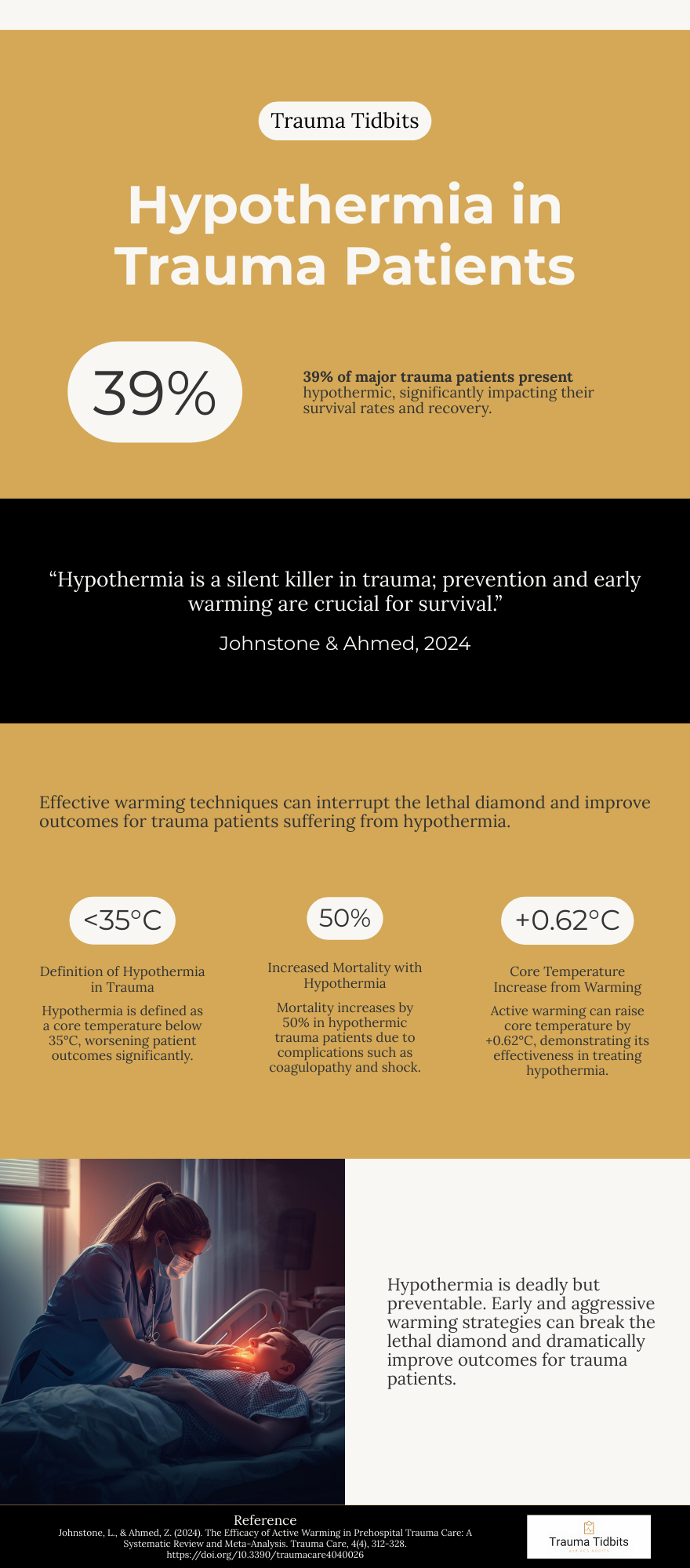
Trauma clinicians know that few things send a trauma activation sideways faster than a core temperature <35 degrees Celsius. Hypothermia in trauma patients isn’t just an uncomfortable side effect—it’s a full‑fledged physiological saboteur. And just like that one unreliable friend, it tends to show up at the worst possible time.
Hypothermia in trauma is common, dangerous, and sneakier than many providers realize. It affects everything from clotting to cardiac function, and if left unchecked, it plays a starring role in the notorious “trauma diamond of death”: hypothermia, acidosis, coagulopathy, and hypocalcemia (Trauma Nurse, 2024). That’s right—cool patients can crash a lot faster than cool colleagues.
Let’s dig into why trauma patients get cold, what happens when they do, and why warming is one of the most important—and easiest—interventions in trauma care.
Why Trauma Patients Become Hypothermic (Even in Arizona)
Trauma patients often show up already losing the battle for normothermia. Severe injuries, shock, exposure, prehospital environmental conditions, and even prehospital procedures can all contribute. One study found 39% of major trauma patients arrived hypothermic, with older age, certain injury locations, and low ambient temperature significantly increasing risk (Akena et al., 2025).
And if the prehospital setting doesn’t cool them down, the hospital might finish the job with:
Cold IV fluids
Cold blood products
Long OR times under anesthesia
Good old‑fashioned exposure (a.k.a. “trauma strip‑and‑flip”)
(Proksch, n.d.).
Even seemingly benign factors—like wet clothing or prolonged extrication—can turn a trauma patient into a popsicle.
What Hypothermia Does: The Physiology Behind the Mayhem
Once a trauma patient cools down, things get complicated quickly. Hypothermia impacts nearly every body system:
Neurological: Decreased cerebral metabolism, confusion, and loss of reflexes at lower temps (Proksch, n.d.).
Cardiac: Bradycardia, conduction delays, and risk of ventricular fibrillation below 25°C (Proksch, n.d.).
Hematologic: Platelets and clotting factors lose effectiveness, worsening bleeding and fueling coagulopathy (Proksch, n.d.).
And yes—the diamond strikes again. Hypothermia worsens bleeding, which worsens acidosis, which worsens hypothermia, which… you get it. It’s the world’s least fun merry‑go‑round.
The consequences are profound: hypothermia increases transfusion requirements, length of stay, and mortality (Proksch, n.d.; Moffatt, 2013).
Why Warming Matters: Keeping Patients Out of the Cold
Warming isn’t just “nice to do”—it’s life‑saving. Recognizing the importance of early warming, the Joint Trauma System updated its clinical practice guideline in 2023, emphasizing warming from the prehospital phase onward (Joint Trauma System [JTS], 2023).
Even better: warming works. A meta‑analysis found active warming increased core body temperature by 0.62°C—a meaningful difference for a deteriorating trauma patient (Johnstone & Ahmed, 2024).
In addition, warming helps:
Interrupt the lethal triad
Improve hemodynamics
Reduce ICU length of stay
Improve the success of resuscitation
And in a prospective observational study, most hypothermic patients rewarmed to normal within 30 minutes using blankets, warming devices, and heated IV fluids (Akena et al., 2025).
How to Warm a Trauma Patient (Without Starting a Campfire)
Approaches to warming fall into two categories:
1. Passive Warming
Remove wet/cold clothing
Increase room temperature
Cover with warm blankets
Limit unnecessary exposure
(Proksch, n.d.).
2. Active Warming
Forced‑air warming (Bair Hugger)
Radiant warmers
Heating pads
Warmed IV fluids
Warmed blood products
Warm transport and hypothermia‑prevention gear in EMS
(Proksch, n.d.; JTS, 2023).
As the literature suggests, preventing hypothermia is always easier than treating it—and it’s one of the simplest, lowest‑cost interventions in trauma resuscitation.
Bottom Line: In Trauma, Warm Is the New Stable
Hypothermia in trauma patients is common, dangerous, and absolutely preventable. Warming measures are fast, simple, inexpensive, and backed by robust evidence. Whether your trauma bay is state‑of‑the‑art or held together with duct tape and determination, warming should be as routine as airway management.
In other words: warm early, warm often, and don’t let the triad win.
Don’t let your patients become popsicles—check your warming equipment and protocols before the next trauma rolls in.
If you want a printable hypothermia teaching sheet for your trauma bay, download it here.
References
Akena, P., Kiweewa, R., Olum, R., Basenero, A., Nabulya, R., Nabawanuka, A., & Mugisa, D. (2025). Factors associated with hypothermia and its response to resuscitation among major trauma patients. BMC Emergency Medicine. https://link.springer.com/article/10.1186/s12873-025-01254-4
Hostetler, A. (2026). Hypothermia prevention in major trauma patients. Doctor of Nursing Practice Scholarly Projects, Otterbein University. https://digitalcommons.otterbein.edu/stu_doc/160/
Johnstone, L., & Ahmed, Z. (2024). The efficacy of active warming in prehospital trauma care: A systematic review and meta-analysis. Trauma Care, 4(4), 312–328. https://www.mdpi.com/2673-866X/4/4/26
Joint Trauma System. (2023). Hypothermia: Prevention and Treatment Clinical Practice Guideline. https://jts.health.mil/assets/docs/cpgs/Hypothermia_Prevention_Treatment_07_Jun_2023_ID23.pdf
Moffatt, S. E. (2013). Hypothermia in trauma. Emergency Medicine Journal, 30(12), 989–992. https://emj.bmj.com/content/30/12/989
Proksch, D. (n.d.). Hypothermia management in trauma patients. Texas Tech University Health Sciences Center. https://ttuhscep.edu/cme/_documents/Hypothermia_in_Trauma_-_Proksch.pdf
Trauma Nurse. (2024). 4 facts about the lethal trauma diamond that nurses should know. Trauma System News. https://trauma-news.com/2024/05/4-facts-about-the-lethal-trauma-diamond-that-nurses-should-know/