
ED Trauma Room Setup Must‑Haves
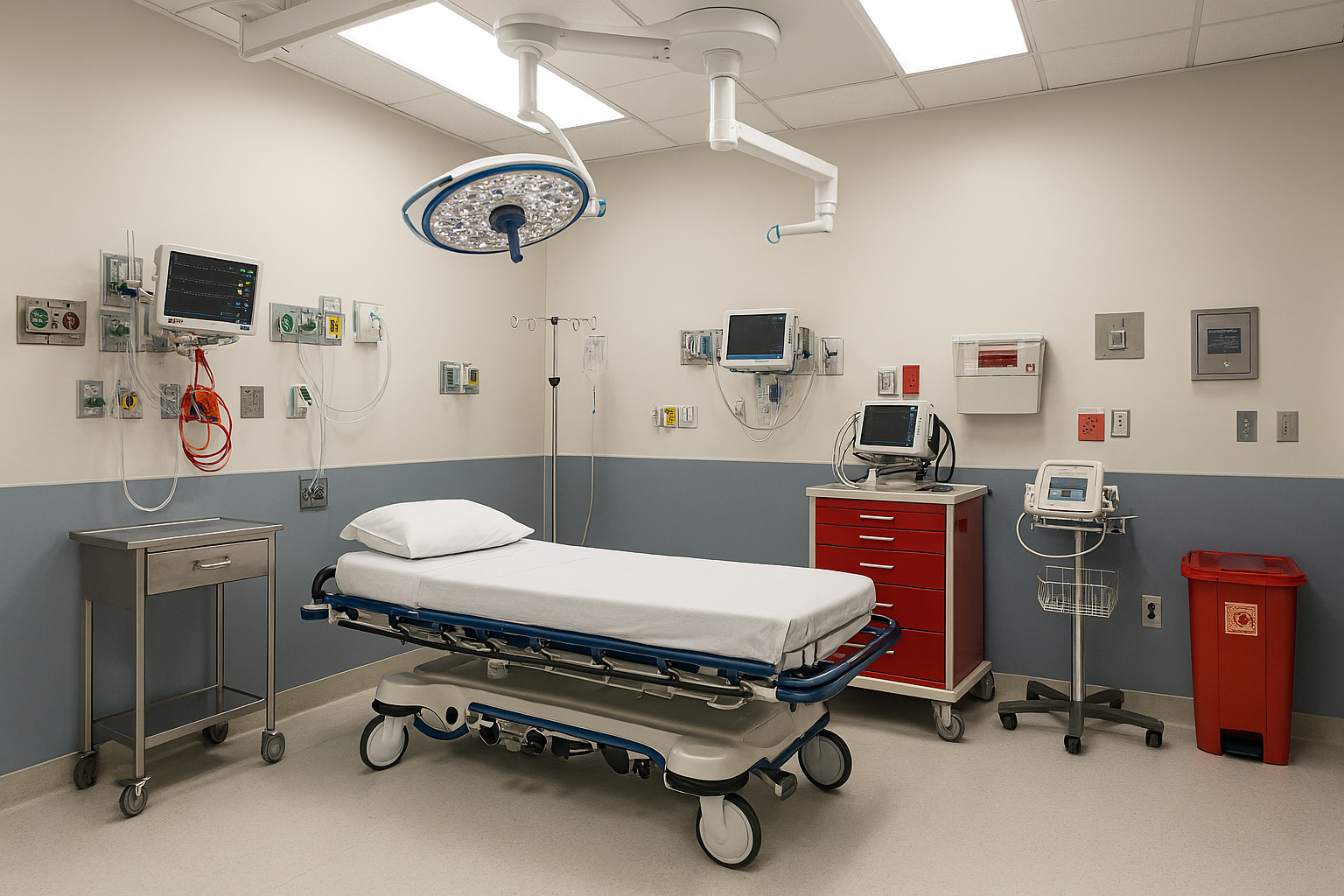
In the Emergency Department (ED), the trauma room is where precision meets pandemonium. It’s a high‑stakes environment where clinicians transform split‑second decisions into life‑saving outcomes—provided the room is stocked, organized, and designed for speed. This guide outlines the essential elements every trauma room needs, across all ages and acuity levels, supported by evidence‑based recommendations and a healthy dash of humor.
1. Airway & Ventilation: Because Breathing Is Non‑Negotiable
A trauma bay without airway equipment is like a kitchen without a stove—nothing important happens. Essential airway tools include bag‑valve masks, suction devices, oropharyngeal and nasopharyngeal airways, supraglottic devices, and video laryngoscopes (National Athletic Trainers’ Association, 2024; Mississippi State Department of Health, 2020).
For pediatric patients, airway management demands size‑appropriate tools such as pediatric BVMs, pediatric OPAs/NPAs, pediatric supraglottic devices, and oxygen delivery devices scaled for young lungs (Mississippi State Department of Health, 2020). Broselow tape helps clinicians quickly identify correct pediatric airway sizing—because guessing is not a strategy.
2. Circulation & Hemorrhage Control: Stop the Bleed, Save a Life
Trauma patients have a tendency to leak—sometimes alarmingly. Equipment for hemorrhage control includes commercial tourniquets, wound packing material, sterile gauze, occlusive dressings, and large‑bore IV catheters (National Athletic Trainers’ Association, 2024; Mississippi State Department of Health, 2020).
Pediatric needs differ: micro‑bore IV catheters, pediatric intraosseous needles, and age‑appropriate blood pressure cuffs must be available (Mississippi State Department of Health, 2020)..
Because nothing slows resuscitation like a cuff that’s bigger than the patient’s whole arm.
3. Monitoring & Diagnostics: The Trauma Room Dashboard
Real‑time physiologic data is the lifeblood of trauma care. Pulse oximetry, ECG monitors, capnography, blood pressure cuffs, defibrillators, and ultrasound must be readily available (Mississippi State Department of Health, 2020)
For kids, this means pediatric‑sized ECG electrodes, pediatric SpO₂ sensors, and defibrillators capable of delivering pediatric‑safe energy doses (Mississippi State Department of Health, 2020).
4. Medication Arsenal: Pharmacologic Firepower
From naloxone to epinephrine, from bronchodilators to glucose, medications in a trauma room represent a life‑saving pharmacologic toolkit (National Athletic Trainers’ Association, 2024).
Pediatric medication safety requires weight‑based dosing, which means Broselow carts, dosing guides, and pre‑labeled syringes. When seconds matter, math is not your friend—tools that eliminate calculation errors are vital.
5. Procedural & Surgical Supplies: Tools for the Toughest Moments
Trauma teams must be prepared for emergency procedures including thoracostomy, cricothyrotomy, central line insertion, and intraosseous access. These require stocked procedural kits and sterile surgical sets (Mississippi State Department of Health, 2020).
Pediatric adaptations include child‑sized cervical collars, immobilization devices, and thermal control equipment—because children lose heat rapidly and hypothermia can worsen outcomes (Mississippi State Department of Health, 2020).
6. Room Design & Ergonomics: Layout That Saves Lives
Trauma room design significantly influences patient flow and safety. Evidence‑based design recommendations include clear layouts, adequate workspace, accessible storage, good lighting, PPE accessibility, and ergonomic equipment placement (Kent State University, 2024).
These principles apply to pediatric care as well, especially ensuring that critical pediatric supplies are co‑located and easy to identify, often via color‑coding (e.g., Broselow zones).
7. Preparation & Team Awareness: No Scavenger Hunts Allowed
A trauma room can only save lives if clinicians know where everything is. All equipment should be stocked before patient arrival, and the entire team should be familiar with its location and use (Upstate Golisano Children’s Hospital, n.d.).
The trauma bay is not the place to play “Where’s Waldo?” with your thoracostomy kit.
8. Pediatric‑Specific Essentials: Because Kids Aren’t Just Small Adults
A truly ready trauma room includes full pediatric capability. Trauma care for infants and children requires precise sizing, different physiologic assumptions, and additional safety steps. Pediatric must‑haves include:
Pediatric airway tools (BVMs, OPAs, NPAs, supraglottic devices)
Broselow tape and color‑coded resuscitation carts
Pediatric oxygen masks, nasal cannulas, and SpO₂ probes
Pediatric IV catheters, IO needles, and microdrip sets
Pediatric‑sized BP cuffs and ECG electrodes
Thermal control devices
Pediatric cervical collars and immobilization tools
These items are essential for rapid, safe, and developmentally appropriate trauma care (Mississippi State Department of Health, 2020).
Conclusion
A trauma room can only be as ready as the system used to evaluate it. That’s why this article proudly directs you not to a generic checklist, but to a Trauma Equipment Audit Tool—a comprehensive, structured, ACS‑aligned resource tailored for real‑world ED readiness.
Your checklist includes:
Airway & ventilation requirements
Hemorrhage control and vascular access essentials
Monitoring & imaging checkpoints
Surgical and procedural readiness
Communication and environmental elements
Medication and consumable standards
Pediatric requirements
Built‑in scoring, notes, and sign‑off sections
It’s practical, user‑friendly, and built for trauma teams who take readiness seriously.
👉 Download Your Trauma Equipment Audit Checklist
Use it during:
Quarterly trauma bay audits
Trauma simulations and mock codes
ACS readiness reviews
PI and equipment standardization efforts
Because a trauma room that isn’t audited regularly is a trauma room that’s not truly ready.
Conclusion: Readiness Isn’t Optional
A well‑equipped ED trauma room is not a luxury—it’s a moral and clinical imperative. It drives faster interventions, prevents errors, and saves lives. Whether caring for a multi‑system trauma, a pediatric emergency, or anything in between, the readiness of the room defines the readiness of the team.
References
National Athletic Trainers’ Association (2024). Emergency equipment list recommendations. https://natad2.org/wp/wp-content/uploads/2025/03/Foundation_EAP_EAP-emergency-equipment-list-recommendations_2024.pdf
Kent State University. (2024). Design guidelines for trauma rooms. https://www-s3-live.kent.edu/s3fs-root/s3fs-public/file/DesignGuidelines.pdf
Mississippi State Department of Health (2020). Trauma center essential and desirable list for equipment. https://msdh.ms.gov/msdhsite/_static/resources/10243.pdf
Upstate Golisano Children’s Hospital. (n.d.). Preperation for equipment for resuscitation. https://www.upstate.edu/gch/pdf/services/trauma/12-preparation-and-equipment-for-resuscitation.pdf
