
The PI Committee Structure in Trauma: Where Serious Work Meets Seriously Good Structure
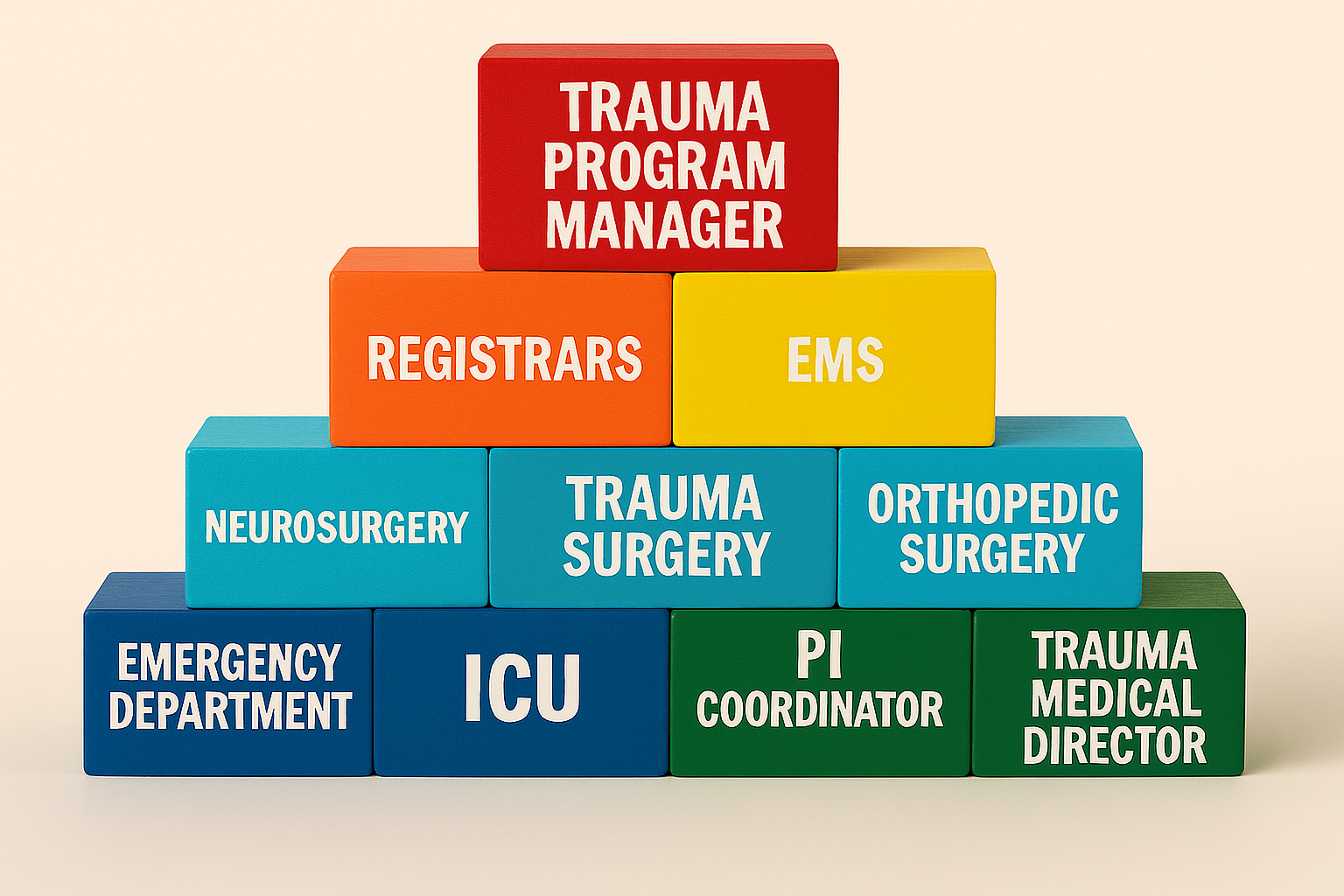
Trauma care is not for the faint of heart—but neither is the structure behind the scenes keeping it all running smoothly. Enter: the Performance Improvement (PI) Committee, the engine in the background ensuring trauma programs don’t just function but truly excel. If trauma resuscitation is the dramatic front-of-house performance, the PI committee is the backstage crew pulling ropes, adjusting lights, and occasionally whispering, “Let’s not do that again.”
A well-organized PI structure is not only a requirement of trauma verification bodies but the backbone of quality, safety, accountability, and continuous learning. And yes, it can even be a little fun—especially if you enjoy data, process flow, and the thrill of loop closure.
Why Trauma Needs a PI Committee (Besides the Fact That ACS Says So)
The American College of Surgeons defines performance improvement as a “continuous process of monitoring, assessment, and management directed at improving care” (Wisconsin STAC, 2024).
Translation: trauma care is a never‑ending group project, and someone needs to make sure everyone is actually doing the group work.
Trauma PI committees promote multidisciplinary problem‑solving, reduce preventable complications, and improve outcomes by systematically reviewing how care was delivered rather than assuming all went perfectly simply because the CT scanner didn’t catch fire. PI gives trauma programs the structure to identify issues, validate them, create actions, and confirm that those actions worked—otherwise known as the sacred ritual of loop closure (Froedtert & Medical College of Wisconsin, 2024).
Anatomy of a Well‑Run Trauma PI Committee
1. A Multidisciplinary Cast of Characters
A PI committee is at its best when it’s made up of the professionals who see trauma care from every angle—surgeons, emergency physicians, EMS reps, registrars, program managers, and more (Pennsylvania Trauma Systems Foundation, 2016; Wisconsin STAC, 2024).
This mix ensures discussions remain balanced, collaborative, and occasionally spicy.
2. A Clearly Defined Review Structure
Most trauma systems follow multiple review levels such as:
Primary Review: Initial chart check by PI or registry staff
Secondary Review: Medical Director analysis and decision‑making
Tertiary/Quaternary Review: Committee-level discussions, M&M, or even external review when necessary
This tiered approach ensures no issue falls through the cracks—and that the right people see the right problems at the right time (Froedtert & Medical College of Wisconsin, 2024).
3. A Commitment to Data (Because Numbers Don’t Lie, but People Sometimes Do)
Trauma PI is built on data from sources such as trauma registries, EMS reports, transfer records, and autopsy findings (Wisconsin STAC, 2024).
These sources feed the committee with the raw material needed to identify trends and opportunities for improvement.
4. The Magic of Loop Closure
The heart and soul of PI is closing the loop—ensuring corrective actions never languish in the “good idea” category. Loop closure may take the form of education, guideline updates, competency checks, or system redesign (Froedtert & Medical College of Wisconsin, 2024).
Without loop closure, PI becomes just an expensive discussion club. With it, trauma programs transform care.
The Culture Behind the Committee
A truly effective PI committee doesn’t rely solely on structure—it thrives on culture. Transparency, curiosity, and psychological safety are essential. As PI experts note, one of the biggest barriers to effective trauma PI is lack of standardized processes and inconsistent expectations (White, 2020).
In other words, PI shouldn’t feel like a witch hunt. It should feel like a team huddled around a puzzle, trying to make the picture a little clearer and a lot safer.
Why It All Matters
When done well, Trauma PI committees:
Improve patient outcomes
Reduce morbidity and mortality
Prevent repeat errors
Strengthen trauma team competency
Maintain regulatory compliance
Build a culture of accountability and growth
Put simply: PI committees keep trauma centers honest, effective, and evolving—one audited case at a time.
Conclusion: Strengthen Your PI Structure Today
Whether you’re a coordinator, director, surgeon, or bedside clinician, you play a part in trauma improvement. Look at your current PI structure and ask:
Are all necessary disciplines at the table?
Are review levels clearly defined and consistently applied?
Are loop closures meaningful, timely, and trackable?
Does the team embrace transparency and learning?
If the answer to any of these is “probably not,” now is the perfect time to refine your PI processes. A strong PI committee doesn’t just review trauma care—it transforms it.
Be the reason your trauma program moves from functioning to exceptional. Your patients—and your future verification reviewers—will thank you.
References
Froedtert & Medical College of Wisconsin. (2024). Trauma performance improvement and patient safety guideline. https://www.froedtert.com/sites/default/files/upload/docs/services/trauma/guidelines/trauma-performance-improvement-patient-safety-guideline.pdf [froedtert.com]
Pennsylvania Trauma Systems Foundation. (2016). Level III performance improvement plan (TRU‑05). https://www.ptsf.org/wp-content/uploads/2020/10/Level_III_PI_Plan.pdf [ptsf.org]
White, C. (2020). Trauma Performance Improvement [Presentation]. Trauma Managers of California. https://www.traumamanagersca.org/_docs/Trauma_Performance_Improvement.White_.pdf
Wisconsin Statewide Trauma Advisory Council (STAC). (2024). Regional performance improvement process guidelines. https://www.dhs.wisconsin.gov/stac/regional-improvement-process-guide.pdf
