
Commanding the Chaos: Why Role Clarity for the Trauma Team Lead Matters More Than Caffeine on a Night Shift
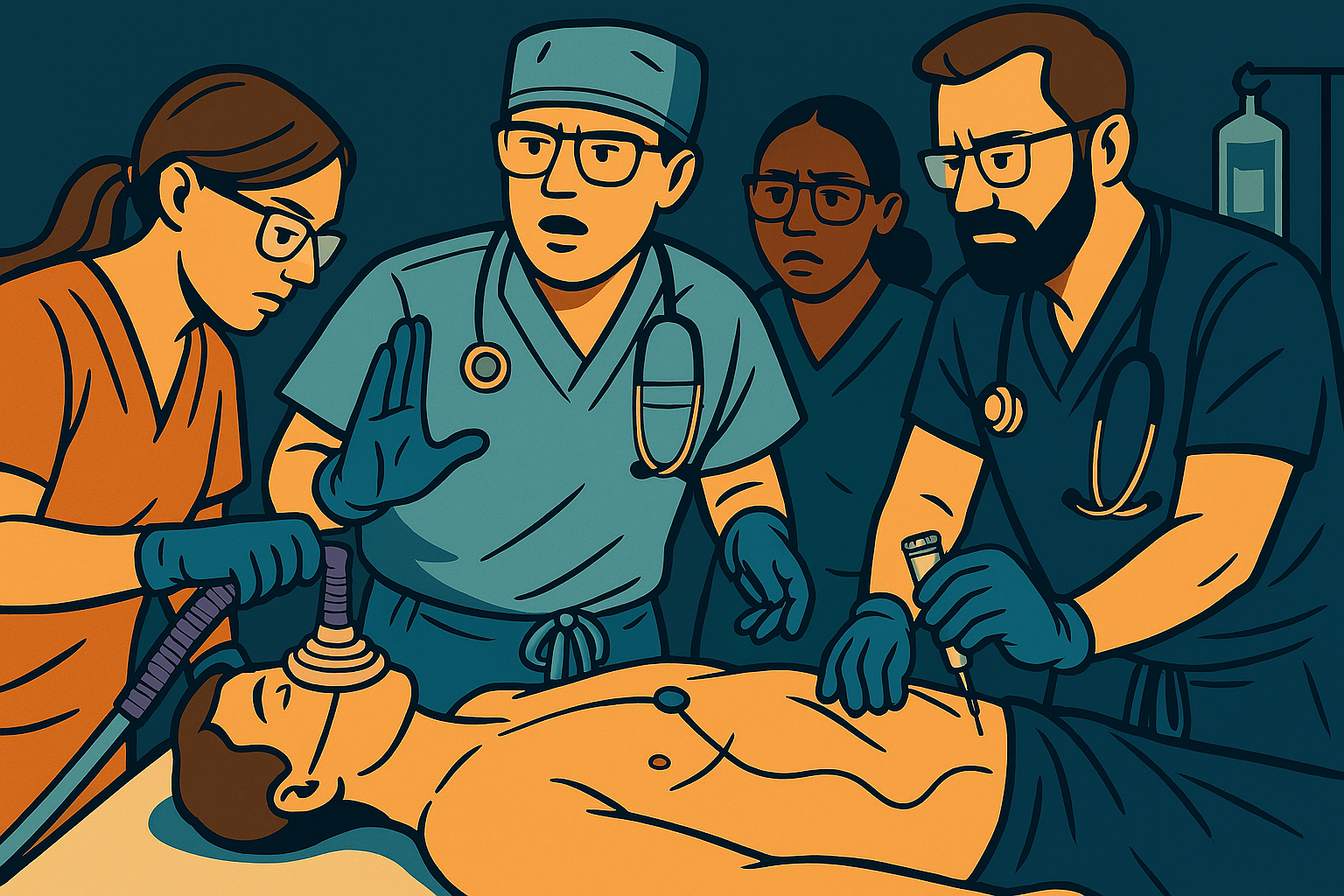
When trauma rolls through the emergency department doors, the scene can feel like a cross between a high‑stakes orchestra performance and controlled pandemonium. Monitors beep, gurneys fly, someone always seems to be yelling for suction, and at least one person is trying to find a pulse that may or may not exist.
In moments like these, role clarity—especially for the trauma team lead—is not optional; it’s survival.
Why a Clear Leader Prevents Collective Panic
Research consistently shows that having a designated trauma team leader improves the synchronization, communication, and efficiency of the team’s response (Appelbaum & Streams, 2025). The leader, often called the trauma captain, serves as the cognitive anchor in an environment where clinical urgency can easily outpace coherent thought. Strong leadership accelerates critical tasks such as the initial assessment, prioritization, and decision‑making—functions essential to preventing both under‑ and over‑triage (Appelbaum & Streams, 2025; Ford et al., 2016).
ATLS, long the gold standard in trauma care education, emphasizes leadership as a core competency because coordinated effort outperforms chaotic enthusiasm every time (American College of Surgeons Committee on Trauma, as discussed in Appelbaum & Streams, 2025).
In short: everyone may know what to do, but someone needs to decide when and in what order.
What Exactly Does the Trauma Team Lead Do? (Hint: Everything but Intubate the Intubator)
Most operational trauma policies define the team leader as the conductor of the resuscitation, responsible for making clinical decisions, determining priorities, and delegating tasks clearly and continuously (University of New Mexico Health Sciences Center, n.d.).
This includes:
Running the primary and secondary assessment without being the one physically performing every task.
Announcing findings and decisions clearly—preferably loudly enough to be heard over the suction but calmly enough to prevent anyone from panicking.
Ensuring procedures occur in sequence and that information flows in a single, centralized direction rather than spiraling into a vortex of overlapping commands.
Coordinating with emergency medicine, trauma surgery, nursing, respiratory therapy, and ancillary staff to ensure an aligned clinical approach (UNM HSC, n.d.).
When done well, the trauma leader essentially functions as the team’s executive CEO, quality control specialist, and narrator all at once.
The Cost of Confusion: When Roles Blur, Care Suffers
Role ambiguity during trauma activation risks duplicated tasks, missed interventions, delayed decisions, and a general uptick in stress—none of which are conducive to patient survival. Literature on trauma activation processes emphasizes the need for standardized protocols and clearly defined responsibilities to optimize outcomes, reduce response time, and enhance both patient and staff satisfaction (Nurlaelah et al., 2024).
When everyone feels like the leader, no one actually is. And when no one is the leader, someone inevitably starts doing a FAST exam while another person simultaneously tries to cut off the patient's clothes with the ultrasound probe.
Leadership Is Not a Personality Trait—It’s a Trainable Skill
Contrary to popular belief, great trauma team leads are not born with superhuman calm or psychic diagnostic capabilities. Many leadership behaviors can be shaped through training, feedback, and simulation (Appelbaum & Streams, 2025). Recent research underscores the value of leadership assessment tools, trauma video review, and simulation‑based education in improving both team function and patient care.
This aligns with broader trauma‑informed leadership frameworks, which emphasize emotional intelligence, clarity, and the ability to regulate chaos even when chaos seems determined to win (Lloyd, 2024).
Clarity Isn’t Bossiness—It’s Clinical Safety
The trauma team lead isn’t a dictator; they’re a facilitator of fast, safe, organized care. Role clarity ensures that:
Tasks are performed once, correctly, and by the appropriate provider
Communication channels remain structured
Cognitive load is distributed, not dumped
Critical decisions are made efficiently
And yes—the patient actually benefits (which is why we’re all here)
In a setting where seconds matter and confusion kills, clear leadership isn’t just helpful—it’s life‑saving.
Trauma activations are never going to be calm, but they can be coordinated. As you step into your next resuscitation, commit to strengthening role clarity—starting with the team lead. Make it a habit to name the leader early, communicate expectations loudly, and model the kind of organized calm that keeps the team on track and the patient alive.
Whether you’re educating new staff, revising protocols, or simply trying to tame the daily chaos of the trauma bay, take the next step: advocate for clear leadership roles, promote ongoing simulation training, and champion consistent communication practices.
Because in trauma care, clarity isn’t a luxury—it’s the difference between confusion and coordinated, life‑saving action. Let’s build teams that lead confidently, respond intelligently, and resuscitate with purpose.
Step up. Speak up. Lead clearly. Your team—and your patients—depend on it.
References
Appelbaum, R. D., & Streams, J. R. (2025). Importance of leadership in the trauma bay. Current Trauma Reports, 11(18). https://doi.org/10.1007/s40719-025-00292-4
Lloyd, R. C. (2024). Trauma-informed leadership: Integrating research-based leadership theories and SAMHSA principles for building resilient teams. Regent Research Roundtables. https://www.regent.edu/wp-content/uploads/2024/03/Regent-Research-Roundtables-2024-Servant-Leardership-Lloyd.pdf
Nurlaelah, S., Kamal, A. F., Dewi, I., Mansyur, M., & Bardosono, S. (2024). Trauma team activation in the emergency department: A literature review of criteria, processes and outcomes. Malaysian Journal of Medicine and Health Sciences, 20(1), 323–329. https://doi.org/10.47836/mjmhs.20.1.40
University of New Mexico Health Sciences Center. (n.d.). Trauma team roles and responsibilities for trauma activation patients. https://hsc.unm.edu/medicine/departments/emergency-medicine/_docs/edru/trauma-roles.pdf
