
Trauma Bay Readiness: Because Chaos Deserves a Well‑Organized Stage
If the emergency department (ED) were a theatre, the trauma bay would be its high‑stakes main stage—where the script is unpredictable, the stakes are life‑and‑death, and the actors are expected to perform flawlessly under pressure. Trauma bay readiness is not optional; it is the backbone of safe, effective trauma care. And like any great production, readiness hinges on planning, practice, and having the right equipment in the right place at the right time.
Why Trauma Bay Readiness Is Non‑Negotiable
Trauma remains one of the leading causes of death among adults under 45, making the trauma bay a critical space for rapid assessment and intervention (Tien et al., 2025). Unfortunately, trauma teams are statistically more prone to communication errors—up to 2–4 times more than other hospital teams—which directly impacts patient outcomes (Tien et al., 2025).
In other words: the most chaotic room needs to be the most prepared room.
Elements of a Truly “Ready” Trauma Bay
1. Role Clarity: Where You Stand Matters
In one innovative redesign, trauma bays equipped with color‑coded floor markers and matching lead aprons dramatically improved workflow and clarity of team member roles. Prior to implementation, less than half of team members knew where to stand; afterward, that number jumped to 90% (Tien et al., 2025).
Clear roles don’t just improve efficiency—they reduce confusion in the moments where confusion costs lives.
2. Competency and Training: Readiness Starts Before the Activation
Level I trauma centers such as Vanderbilt require detailed orientation and competency validation for every role that steps into the trauma bay—including PCTs, paramedics, nurses, respiratory therapists, and more (High, 2011).
The message is simple: trauma readiness isn’t conferred by job title—it’s earned through preparation.
3. Evidence‑Based Protocols and Standardized Processes
Major organizations such as the American College of Surgeons and the authors of the University of California San Diego (UCSD) Trauma Handbook outline standardized processes for airway management, massive transfusion, radiology, trauma labs, safety procedures, and overall resuscitation flow (UCSD, 2024; American College of Surgeons, n.d.).
These aren’t decorations on a shelf—they’re the blueprints for survival.
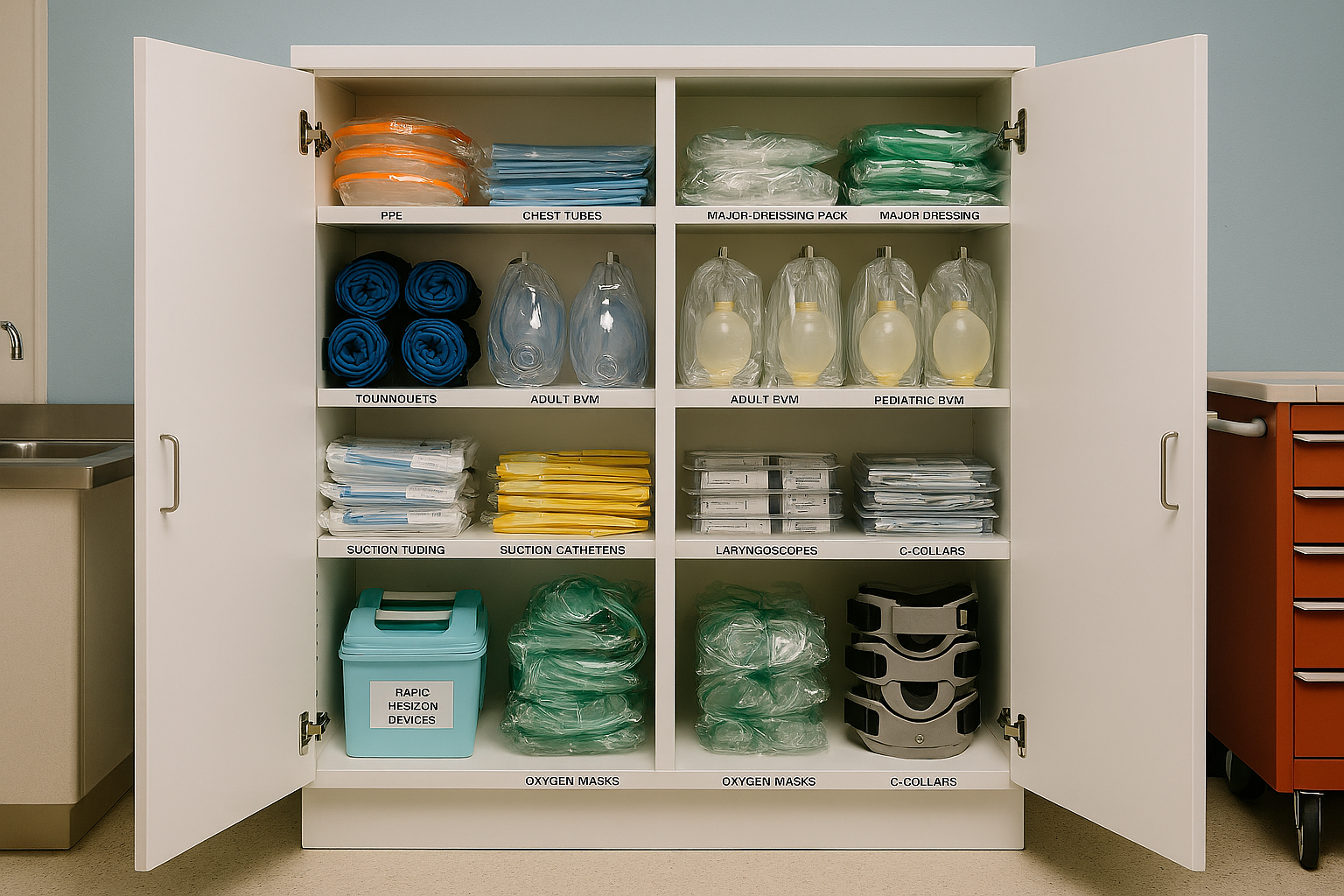
4. Equipment Readiness: The Often‑Forgotten Cornerstone
A trauma bay can have the best people, the sharpest protocols, and an impeccable workflow—but if the equipment isn’t ready, none of it matters.
Ready equipment means:
PPE that is accessible and appropriate, such as the lead aprons implemented in the redesigned trauma bay, which significantly improved staff adherence to radiation safety and reduced task interruptions (Tien et al., 2025).
Critical supplies positioned consistently, following best‑practice placement outlined in trauma handbooks and ED readiness checklists (UCSD, 2024).
Functional monitoring, lighting, suction, and airway equipment, all checked prior to activations.
Trauma‑specific equipment, such as rapid infusion devices, chest tube trays, and hemorrhage control tools, kept stocked and standardized.
In essence: equipment readiness is the silent partner of clinical readiness—when it works, no one notices; when it doesn’t, everyone suffers.
5. Pediatric Readiness: Because Trauma Isn’t One‑Size‑Fits‑All
More than 80% of pediatric emergency visits occur in general EDs, not specialized pediatric centers. High pediatric readiness is associated with lower mortality and fewer disparities in care (NPRP, 2021; American Board of Emergency Medicine, 2025).
True readiness recognizes that small patients have big needs.
Readiness Is a Culture, Not a Checklist
You can color‑code your bay, laminate your protocols, and stock every drawer with military precision. But readiness thrives inside a culture—one that values communication, continuous improvement, and curiosity.
It is the sum of:
Systems (like protocols and workflows)
Skills (from training and drills)
Stuff (equipment readiness)
Spirit (the culture of a high‑performing trauma team)
And when these elements align, chaos becomes manageable and lives are saved.
A Witty but Serious Call to Action
If your trauma bay hasn’t been evaluated lately, consider this your friendly nudge.
Audit your equipment. Refresh your workflows. Revisit your orientation processes. Re‑check your pediatric readiness. And recommit to building a culture where readiness is never an afterthought.
Trauma doesn't schedule its arrival—but you can be ready when it burst through the door.
Want so assistance in making sure you have all the equipment needed in your trauma bay?
Download the Trauma Tidbits Trauma Equipment Audit Checklist here.
References
American College of Surgeons. (n.d.). Best Practices Guidelines. https://www.facs.org/quality-programs/trauma/quality/best-practices-guidelines/
National Pediatric Readiness Project (NPRP). (2021). Pediatric readiness assessment. https://www.pedsready.org/
American Board of Emergency Medicine. (2025). Ensuring optimal outcomes for children by improving pediatric readiness in the emergency department. MyEMCert Key Advances. https://www.abem.org/wp-content/uploads/2024/07/key-advances_-pedicatric-readiness_clinical-policy-alert.pdf [link.springer.com]
Tien, L., Sturdevant, M., Javangula, M., Ange, B., McKenzie, J., Medeiros, R., et al. (2025). Remodeling the trauma bay to improve communication and patient care: A novel approach to trauma resuscitations. Trauma Surgery and Acute Care Open, 10(2),e001689. https://doi.org/10.1136/tsaco-2024-001689
University of California San Diego, Division of Trauma, Surgical Critical Care, Burn, & Acute Care Surgery (UCSD). (2024). Trauma Handbook 6.0. https://surgery.ucsd.edu/_files/trauma-burn/UCSD-TRAUMA-HANDBOOK-6-0-2024.pdf
High, K. (Ed.). (2011). Trauma bay guidebook. Vanderbilt Adult Emergency Department and Trauma Working Interest Group. https://studylib.net/doc/6830955/the-trauma-bay-guidebook---vanderbilt-university-medical-...
