
Vital Sign Sequence & Timing for Trauma Activations
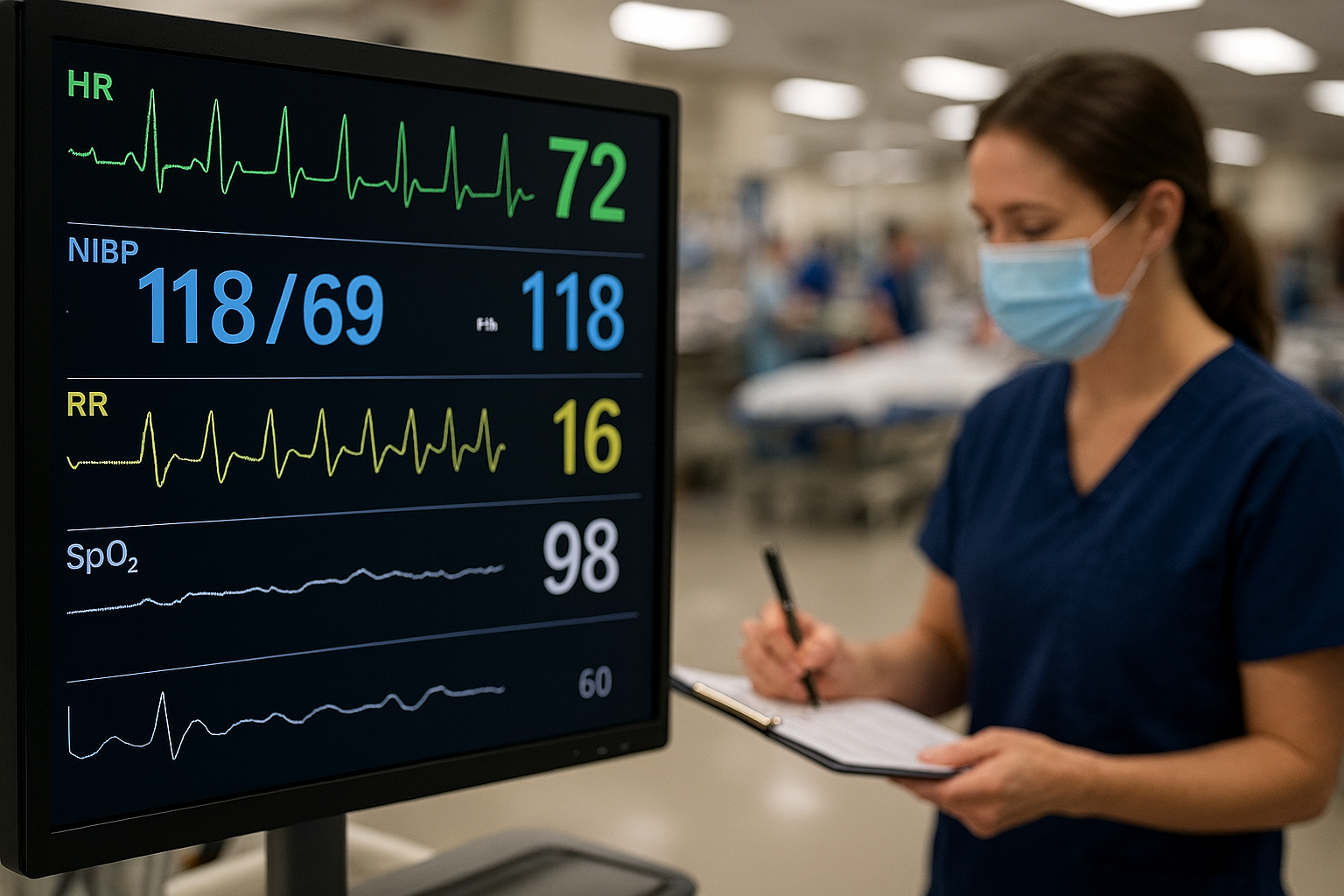
Trauma activations move fast—so fast that even your caffeine struggles to keep up. In the organized chaos of the trauma bay, vital signs are not just numbers; they are the early warning system, the clinical plot twists, and the data breadcrumbs that guide life‑saving decisions. But timing and sequence matter. Document them well, and you look like a resuscitation rockstar. Document them poorly… and quality audits will find you in the chart review dungeon.
This article dives into the why, what, and how of proper vital sign sequencing and timing during trauma activations—bringing evidence, wit, and a gentle nudge to tighten up documentation habits.
Why Vital Sign Timing Matters
Vital signs provide the earliest and often the only objective indicators of physiologic instability. Consistent, timely measurement allows clinicians to detect deterioration early and intervene effectively. Research shows that abnormalities in vital signs often precede adverse events, yet documentation is frequently inconsistent or incomplete, contributing to missed opportunities for stabilization or early escalation of care (Lockhart et al., 2020).
Emergency departments rely on trends—not one‑off numbers—to identify shock, evolving respiratory failure, or silent neurological decline. Without accurate sequence and timing, those trends dissolve into guesswork, and guesswork has no place in trauma care.
What the Guidelines Say: Sequence & Frequency
Although national consensus standards remain limited, trauma guidelines and quality tools offer clear expectations for frequency and completeness of vital sign documentation during trauma activations.
Trauma Activation‑Specific Intervals
Audit tools show recommended intervals during trauma resuscitation, depending on the activation level:
Level 1 Trauma:
Q5 minutes × 20 minutes
Then Q15 minutes × 1 hour
Then Q30 minutes thereafter (Arizona Department of Health, n.d.)
Level 2 Trauma:
Q15 minutes × 1 hour
Then Q30 minutes × 2 hours (Arizona Department of Health, n.d.)
These intervals exist for a reason: unstable trauma patients can change clinical trajectories quickly, and documentation must reflect that pace.
Components of a Complete Trauma Vital Sign Set
A complete set typically includes:
Temperature
SpO₂
Heart rate
Respiratory rate
Blood pressure
Pain score
GCS (ACEM & CENA, 2023)
Initial Sequence on Arrival
Trauma protocols emphasize a consistent order:
Pulse oximetry placement FIRST
Blood pressure & cardiac monitoring
Temperature
Announce values aloud (West Virginia University Medicine, 2023)
Announcing values isn’t just theatrical flair—it synchronizes the team’s situational awareness.
Evidence Behind the Emphasis on Timing
Evidence‑based QI projects show that structured timing guidelines dramatically improve documentation compliance:
One ED increased vital sign documentation over 100% after implementing standardized frequency expectations (Mason et al., 2023).
Missing or mistimed vital signs are linked to increased ICU transfers, code activations, and unplanned inpatient deterioration (Lockhart et al., 2020).
If documentation is inconsistent, clinicians lose crucial physiologic trends—like a slowly creeping respiratory rate or a subtly narrowing pulse pressure—that could have signaled impending collapse.
How to Document Vital Signs Like a Trauma Pro
Here’s the practical, no‑nonsense (but slightly witty) version:
1. Timestamp Everything.
If it isn’t timestamped, it didn’t happen. And no, “within the hour” is not a timestamp.
2. Document in Real Time.
Trauma activations don’t wait, and neither should documentation. If you delay entry, your future self (or your quality department) will regret it.
3. Capture the Sequence Accurately.
Vital signs collected out of order? Note it. Sequence matters for physiologic interpretation and legal clarity.
4. Follow Activation‑Level Intervals.
Level 1 trauma = level 1 urgency in documentation. Stick to the expected Q5/Q15/Q30 structure.
5. Avoid “one and done.”
A single set of vital signs in trauma is like checking the weather once during a hurricane.
6. Announce and Chart.
Say the numbers out loud for team awareness, then enter them immediately. Trauma is a team sport.
The Bottom Line
Trauma resuscitation is complex, but your documentation doesn’t have to be. When vital signs are captured completely, accurately, and on time, they become powerful clinical tools—and protect both patients and providers.
High‑quality documentation = high‑quality trauma care.
Conclusion
Let’s raise the bar.
Whether you’re a bedside nurse, trauma coordinator, educator, or quality reviewer—commit today to improving the accuracy and timeliness of trauma vital sign documentation. Review your department’s guidelines, reinforce expected intervals, speak up when documentation gaps arise, and advocate for workflow improvements that make real‑time charting achievable.
Because in trauma care, every second counts—and every vital sign does too.
References
Arizona Department of Health. (n.d.). Trauma flow sheet documentation audit tool. https://www.azdhs.gov/documents/preparedness/emergency-medical-services-trauma-system/trauma/TraumaFlowSheet-DocumentationAuditTool.pdf
Australasian College for Emergency Medicine & College of Emergency Nursing Australasia (ACEM & CENA). (2023). Joint position statement on vital signs monitoring in emergency departments. https://acem.org.au/getmedia/e3ed668d-7fcb-46f3-bf1a-132d026eff7d/S904_ACEM_CENA_Joint_Statement_Vital_Signs_FINAL
Lockhart, B., Busch, D., & Gabriel, P. (2020). Vital sign monitoring in the emergency department: A quality improvement project [Poster Presentation]. Johns Hopkins School of Nursing. https://nursing.jhu.edu/wp-content/uploads/academics/programs/doctoral/dnp/dnp-projects/spring-2020-dnp-ap/posters/Lockhart_Bridget_Poster_Spr20.pdf
Mason, M. D., Smith, J. L., & Sturla, L. (2023). Implementation of an evidence‑based guideline to improve vital sign assessment and documentation in the emergency department. University of Tennessee. https://trace.tennessee.edu/dnp/102/
West Virginia University Medicine. (2023). Trauma resuscitation protocol. https://wvumedicine.org/criticalcare/wp-content/uploads/sites/31/2024/01/adth-2023-TRAUMA-RESUSCITATION-2.pdf
